
Technical Knowledge Hub & Downloads
Technical explainers, brochures, engineering papers, datasheet requests and installation guidance for Australian project scoping and specification review.
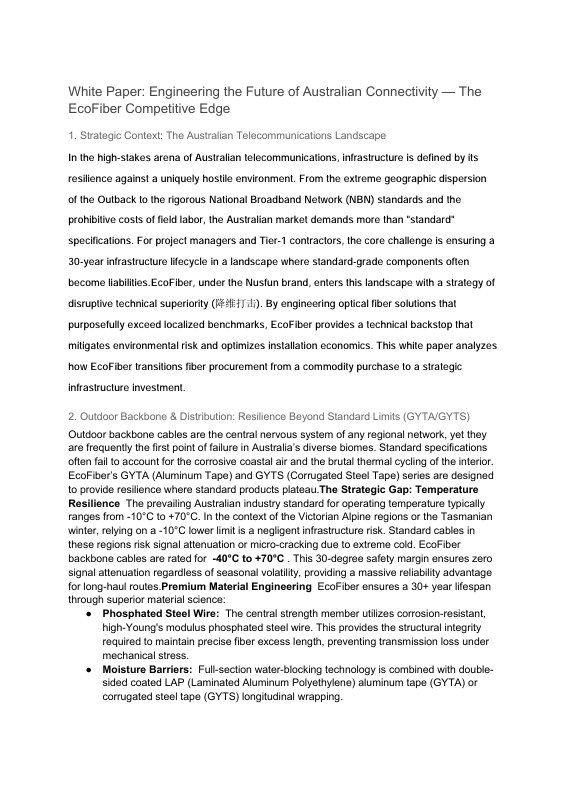
Datasheets & installation guides
Product datasheets and installation guidance are issued per project against the confirmed structure. Email your requirements and we respond with the recommended structure, datasheets and sample options.
- Deployment type: backbone / FTTx / aerial / hybrid / industrial
- Core count — standard or high core count
- Environment: coastal / alpine / outback / duct congestion
- Customisation: colours, stripes, drum lengths, OEM branding
- Project timing and target delivery window

High-density fibre options
The following capabilities are available on a project basis. Final configuration is confirmed against the required application, cable structure, quantity, testing and compliance requirements.
*Maximum fibre count depends on cable construction, application and project requirements.
High-density fibre explained
Short technical answers for project teams evaluating fibre density, installation method and pre-termination options.
Ribbon vs IBR
Conventional ribbon groups fibres into fixed ribbons. Intermittently Bonded Ribbon (IBR) bonds fibres at intervals, allowing the bundle to flex and pack more efficiently while retaining mass-fusion-splicing capability where the selected system supports it.
200 μm vs 250 μm fibre
Reduced-coating-diameter 200 μm fibre can increase packing density compared with conventional 250 μm coated fibre. Cable dimensions and handling depend on the complete cable design and project requirements.
When high fibre count makes sense
Higher fibre density can be useful where duct space, pathway capacity or future expansion is constrained. The commercial case depends on route design, installation method, splicing, redundancy and lifecycle requirements.
MPO/MTP vs field fusion splicing
Factory pre-terminated MPO/MTP assemblies can reduce onsite termination work in suitable structured environments. Field fusion splicing can provide greater route and restoration flexibility. Selection should follow the network architecture and maintenance strategy.
Frequently asked questions
Can EcoFiber supply ultra-high fibre-count cable?
Yes. Suitable high-density cable constructions exceeding 6,000 fibres can be reviewed on a project basis. Final fibre count, structure, dimensions, quantity, tests, lead time and price are confirmed after technical review.
Do you support Ribbon and IBR structures?
Yes. Ribbon and Intermittently Bonded Ribbon (IBR) options can be considered where high fibre density and mass-fusion-splicing efficiency are important. The appropriate structure is selected for the project application.
Are 200 μm fibre and MPO/MTP pre-terminated options available?
Yes, subject to project requirements. 200 μm fibre can support higher packing density, while factory pre-terminated MPO/MTP assemblies can reduce onsite splicing and installation effort. Connector format, polarity, lengths and testing are confirmed before quotation.
Do you hold local stock in Australia?
EcoFiber operates a project-based, factory-to-Australia supply model. Production batches, customisation and import scheduling are planned around project timelines, with lead times confirmed per order.
Can you manufacture non-standard core counts and structures?
Many non-standard core counts and structures can be reviewed. Core count, tube structure, ribbon organisation, sheath, colours, stripes, printing, drum lengths, packaging and OEM branding are confirmed according to technical feasibility, quantity and project requirements.
What fibre grades do you use?
Bend-insensitive G.657 A1/A2 for access and indoor products, and standard single-mode grades for backbone families. Fibre type is specified per product and confirmed on the project datasheet.
Are your products certified for Australian networks?
Compliance and certification positions are confirmed in writing per product and per project. Where a formal document is not yet in place, specifications are provided as subject to project confirmation, and technical details are available upon request.
What are typical lead times?
Lead times depend on structure, volume and shipping schedules, and are confirmed at quotation. Project supply planning is coordinated from Melbourne by Nusfun Pty Ltd.
How do I get datasheets or samples?
Email info@nusfun.com with your deployment type, environment, core count, lengths and customisation needs — we respond with the recommended structure, datasheets and sample options.